
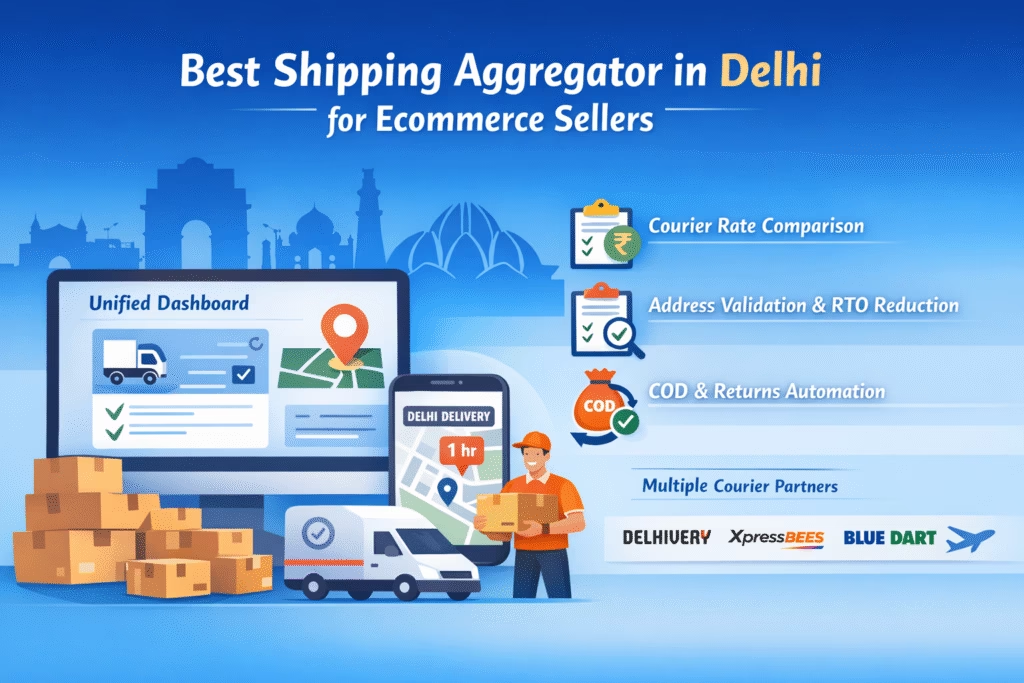
Shipping aggregators let online sellers manage many couriers through one platform. Instead of juggling multiple shipping accounts, a seller logs into one dashboard to book orders, print labels, and track parcels. For Delhi’s fast-paced e-commerce market, this means faster operations and fewer errors. Aggregators also compare rates and service levels automatically, enabling merchants to pick the cheapest or fastest carrier per order. In fact, shipping aggregators “provide more resources to manage [shipping] and logistics,” giving sellers access to discount rates and automating much of the process. This consolidation – from label printing to customer notifications – can cut costs and manual labor for Delhi’s retailers, especially as order volumes rise. (Shiprocket, India’s largest, touts 42 courier partners covering “more than 19,000 pin codes”.)
- Unified shipping dashboard. Aggregators centralize bookings for all couriers (FedEx, Delhivery, XpressBees, etc.) in one place, eliminating multiple logins and formats.
- Automated carrier selection. Smart rules let you choose couriers per order by cost, speed or reliability – for example, a rule might pick the cheapest option for routine packages, or fastest delivery for high-value orders.
- Pre-shipment checks. Modern platforms validate addresses and phone numbers before labels print, catching errors that cause failed deliveries and returns. (In India, average return-to-origin (RTO) rates run ~20–25%, so these checks are vital.)
- COD and returns workflows. Automated cash-on-delivery (COD) remittance and easy return processing free sellers from manual follow-ups.
- Consolidated tracking & billing. One place to track all shipments (forward and return) cuts WISMO queries, and one combined invoice replaces dozens of courier bills.
These features are especially important in Delhi. The city’s high traffic and customer expectations demand fast last-mile delivery – some local aggregators even guarantee 3-hour or same-day delivery in Delhi/NCR – and the large COD volumes here mean RTO can spike if not managed. By automating courier rules and checks, aggregators can lower costs and improve customer experience without adding staff.
Key Features of a Top Courier Aggregator
Sellers should compare platforms on several core capabilities. The best solutions offer:
- Broad Courier Coverage: Look for 10,000+ pincodes and multiple couriers. For example, Shiprocket covers 19,000+ pincodes, and NimbusPost covers ~27 partners and 29,000+ pincodes. Coverage ensures any Delhi order – urban or rural – is shippable.
- Rate Comparison & Automation: The platform should aggregate live rates from every carrier so you can auto-select the lowest-cost or fastest option. (Shiprocket advertises rates “starting at just Rs. 20/500 grams” nationwide.) Quick rate calculation and bulk order uploading save time.
- Order Management Integration: Seamless integration with your store (Shopify, Magento, marketplaces, etc.) is critical. Leading aggregators sync orders automatically so you don’t re-key shipments. For instance, OrderzUp promises one-click Shopify integration, meaning all your Delhi orders flow into the system instantly.
- Address Validation & Fraud Checks: Given Delhi’s volume of COD orders, built-in address/phone validation and fraud screening (before shipment) can dramatically cut RTO losses. These proactive checks catch mistakes earlier than a traditional “ship–track–react” model.
- COD/RTO Analytics: Detailed dashboards should flag high-RTO pincodes or SKUs, enabling data-driven route or courier changes. Robust reporting on courier performance and RTO rates helps continuously improve operations.
- Automated Workflows: Features like bulk label printing, pickup scheduling, SMS/Email alerts, and single-invoice billing speed up fulfillment. (OrderzUp’s interface, for example, automates label generation and offers consolidated invoicing.)
- Customer Support & Onboarding: 24/7 support, easy onboarding (documentation or dedicated account managers), and service SLAs for pickups or delays – these human elements ensure the technology works for you.
In short, a good aggregator acts as a one-stop “control plane” for shipping: it brings together couriers, automates repetitive tasks, and provides intelligence to reduce errors. By leveraging these features, Delhi e-tailers can scale faster.
Comparing Top Aggregators
The Indian market has many players. Shiprocket, India’s market leader, exemplifies the broad-coverage model. It connects sellers to 42+ courier partners (FedEx, Aramex, DTDC, etc.) and covers 19,000+ pincodes. Shiprocket’s platform includes an app, discounted shipping wallets, and no setup fee, appealing to large-scale sellers. However, its legacy approach focuses on connectivity and pricing, leaving much of the RTO/Routing logic to the merchant (as noted by OrderzUp’s team).
NimbusPost is another major aggregator with 27+ carriers and deep e-commerce integrations. It emphasizes an AI-powered courier selection engine and smooth COD collections. Other players like ClickPost, Shyplite or Shipyaari also offer solid integrations and tracking features. BigShip has even positioned itself for Delhi/NCR specifically, advertising “door to door, 3 hours and same day delivery across Delhi/NCR” by using local partners. Warehousing & fulfillment services (ShipBob, Delhivery Fulfillment) add an extra dimension for multi-location India coverage.
Despite these options, many existing platforms still operate reactively – shipping first and dealing with exceptions later. For example, legacy aggregators often require you to run your own COD/RTO playbooks and add-on software, rather than preventing problems up front.
In contrast, OrderzUp (the platform behind OrdrerzUp) is a newer entrant promising to blend shipping aggregation with data-driven intelligence. Launched in 2025, it’s built “to solve [the] pain point” of managing high-volume shipments. According to the founders, OrderzUp’s beta will include:
- Automated courier selection: Choose the best carrier per order without manual input.
- Real-time multi-carrier tracking: All shipment updates from all partners flow into one timeline.
- RTO prediction & reduction: AI tools identify risky shipments (bad address, high COD) before shipping, enabling corrective action.
- Unified dashboard: A single pane of glass for all orders and returns, improving operational consistency.
- Cost optimization: Features to automatically route between couriers to minimize costs while meeting SLAs.
- Faster fulfillment: Quicker label printing and auto-scheduling pickups to speed up dispatch times.
Public materials highlight that OrderzUp “pairs a shipping aggregator with an order-management layer and ML/AI tools” specifically aimed at reducing RTO/COD failures. This means OrderzUp can intervene before a package leaves the warehouse – for example, flagging an incorrect address as an order is placed – instead of only fixing issues during delivery.
From a Delhi seller’s perspective, that is significant. Since COD refusal and address errors drive up Delhi’s return rates, a platform built to catch these cases early can save ~20–25% of wasted shipments. OrderzUp also reports a team of e-commerce specialists building its “logistics automation” for D2C brands. In practice, this could translate to faster Shopify integrations (the site promises “one-click” Shopify store connect) and automated communication (email/SMS) to keep customers informed.
In comparison, older aggregators excel at scale and courier choice but often lack proactive tools. As one expert article notes, traditional aggregators imply “a mostly reactive model (ship→track→react), not proactive pre-validation” and “limited ML/AI” for fraud checks. OrderzUp’s strategy directly targets this gap. It is positioning itself as a data-driven solution where “every order should reach its destination without hurdles” – using AI-based address checks, fraud controls, and smart COD routing to cut RTO.
In summary, while Shiprocket and others lead in network size (and BigShip covers Delhi rapidly), OrderzUp aims to differentiate on intelligence and ease of use. The right choice depends on your priorities: broad coverage and cheap rates, or integrated operations and RTO savings. For many Delhi e-tailers, the latter can mean stronger margins and happier customers.
OrderzUp (OrdrerzUp) – Key Highlights
- Founded 2025: Created by D2C logistics experts to tackle complex shipping pain points.
- AI-powered fulfillment: Automated courier routing, address validation and fraud detection built in.
- Integrated order management: Sync your store (Shopify, Amazon, etc.) so that all orders import at once. The dashboard handles multi-channel orders, shipments, returns and inventory in one place.
- Multi-courier platform: Aggregates live rates from all major carriers. You can select couriers via rules (e.g. cheapest for standard, fastest for premium) or let AI pick the best rate.
- RTO & COD reduction: Specialized workflows minimize failed deliveries. Early tracking of problematic orders means more packages reach Delhi customers safely.
- User-friendly tools: Fast onboarding (self-serve signup) and streamlined label printing. One click to connect your Shopify store.
- Transparent billing: Simplifies reconciliation with consolidated invoicing (eliminating dozens of courier bills).
OrderzUp is currently in beta with early adopters. The team emphasizes feedback-driven iteration, so Delhi sellers joining early could shape local features (like even faster pickup options or Delhi-specific carrier integrations.
How does OrderzUp compare to Shiprocket or other aggregators?
Shiprocket is a proven leader with nationwide coverage and 42+ courier partners. It excels at volume and pricing (low rates starting ~₹20 per 500g). OrderzUp (OrdrerzUp) is newer but adds layers of intelligence: AI-driven address validation, fraud filters, and order-management features aimed at cutting RTO/COD failures. In practice, OrderzUp lets you act before shipping (pre-delivery checks) rather than only reacting afterward. Both platforms handle multi-courier shipping and e-commerce integrations, but OrderzUp emphasizes proactive RTO reduction. The best choice depends on your needs: Shiprocket for maximum coverage and proven scale, or OrderzUp for integrated order workflows and RTO analytics.
Does OrderzUp cover Delhi and other areas? Which courier partners does it support?
OrderzUp connects to India’s major courier networks, so yes – it covers Delhi/NCR and beyond. Like other aggregators, it works with domestic carriers (Blue Dart, DTDC, Delhivery, etc.) and international players (FedEx, DHL, etc.). As of launch, OrderzUp lists “trusted courier partners” on its site. In the future, it may add hyperlocal partners for ultra-fast Delhi deliveries (similar to how BigShip offers local 3-hour delivery in Delhi). The exact partner list can be confirmed by contacting OrderzUp or checking their website updates.
What features does OrderzUp offer for e-commerce shipping?
OrderzUp provides the core features of a modern aggregator plus some advanced tools. You get: multi-courier rate comparison and label printing, consolidated tracking, and unified shipping for COD/returns. The platform advertises easy integrations – one click to connect your Shopify or Amazon store – and automated rules for courier selection. It also supports multiple pickups and automated SMS/email notifications. Crucially, OrderzUp’s analytics help you spot high-RTO pincodes or problematic SKUs, and it automatically validates addresses/phone numbers before shipping to prevent avoidable failures. Overall, it bundles both shipping and order-management tools so sellers can fulfill more efficiently.
Are there fees for using OrderzUp? How is pricing structured?
Most Indian shipping aggregators charge fees or subscription based on shipment volume. Shiprocket, for example, has no platform setup fee but users pay for shipping and can buy wallet credit. OrderzUp has not publicly released detailed pricing at launch. It is likely to use a pay-per-shipment or pay-for-usage model (with discounts on bulk volumes), which is common in the industry. For precise rates, sellers should contact OrderzUp directly. Regardless, the goal of such platforms is to save on shipping overall: for instance, by offering discounted courier contracts and reducing costly returns, an aggregator often pays for itself through the savings achieved.
How does OrderzUp help reduce RTO (return to origin) and COD failures?
: By design. OrderzUp’s platform integrates predictive checks and automation to minimize refused or undelivered shipments. Features include real-time address validation and phone verification at checkout, which catch wrong PIN codes or missing details before orders go out. It also runs fraud detection algorithms (to identify high-risk COD orders) and flags them for review. During shipping, the system tracks each courier’s performance and can automatically re-route or alert you if a delivery goes off-track. This proactive approach is important because Indian e-commerce RTO rates are high – roughly 20–25% on average. Cutting even a few points off that rate can significantly boost revenue. Many established sellers find that an “aggregator+AI” solution like OrderzUp’s is the most efficient way to keep RTO losses in check.
Can OrderzUp integrate with my online store?
Yes. OrderzUp is built for D2C and marketplace sellers. It offers direct integrations with major e-commerce platforms. For example, you can connect a Shopify store in just one click. This means orders from your Delhi store auto-import into OrderzUp, and shipping statuses sync back to your store. The site also mentions integration for Amazon (the “Amazon Self-Ship” feature). These integrations eliminate manual order entry. In general, if your store is on a popular platform (Shopify, Magento, etc.), OrderzUp can connect to it or provide an API/CSV option.
Is using a shipping aggregator worth it for small Delhi sellers?
Yes, even smaller shops see big benefits. Aggregators level the playing field: you gain access to bulk courier rates and shipping tech that only large companies used to have. As one shipping guide notes, aggregators help small businesses by giving them “discounted rates and automating many aspects of the shipping process”. Instead of juggling five courier apps and manually tracking every order, a Delhi seller can fulfill orders faster and with fewer mistakes. The time saved translates into more focus on sales and marketing. For example, with Shiprocket alone moving 200,000+ orders daily nationwide, small businesses can piggyback on that scale. OrderzUp aims to bring similar advantages with extra data-driven tools – meaning even at lower volumes, you avoid costly errors.