
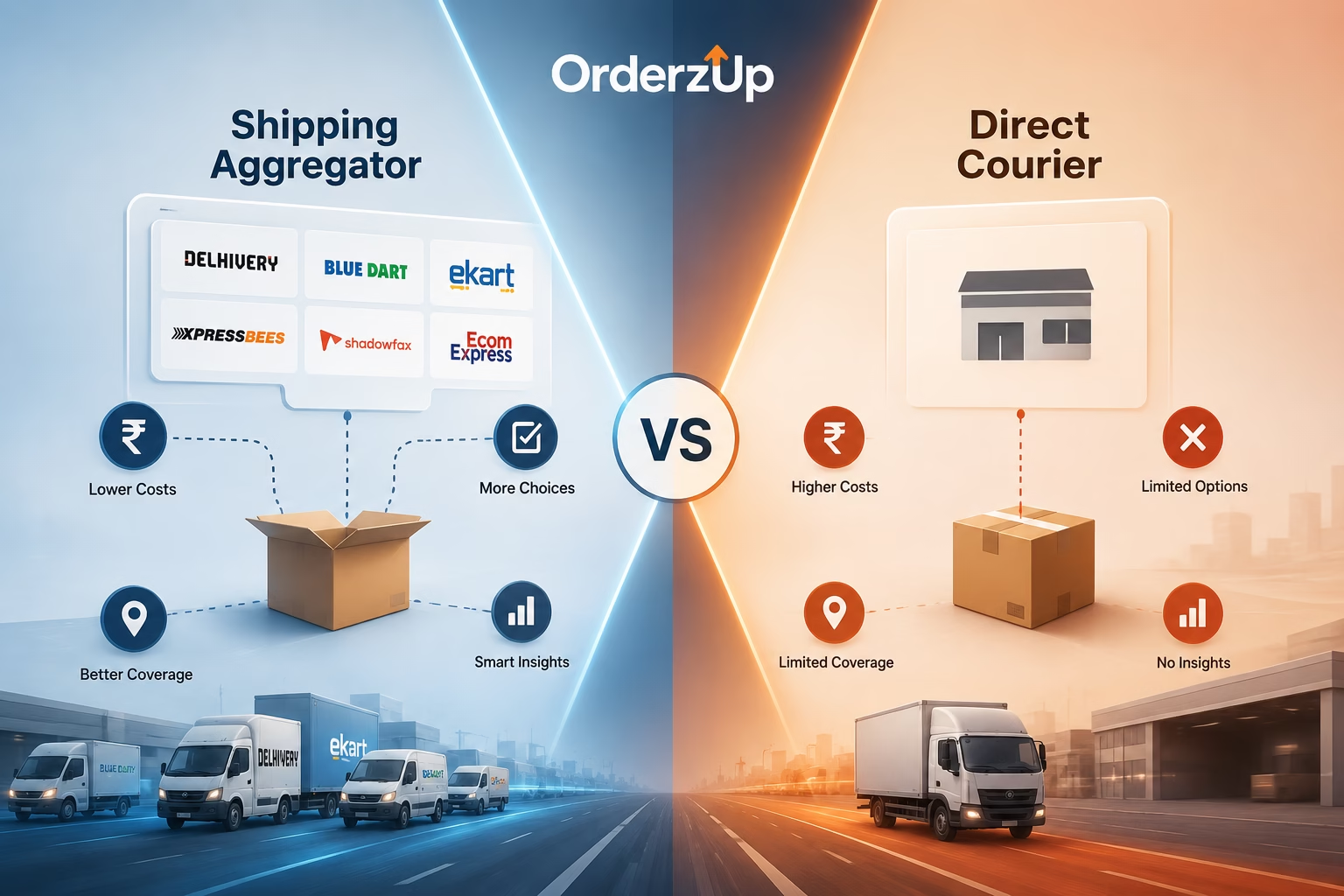
Which Saves More Money for Indian Sellers?
A data-driven breakdown every D2C brand and marketplace seller needs to read in 2026
By Team orderzup.com | Updated: May 2026 | Reading Time: ~12 minutes
The Big Question Every Indian Seller Is Asking in 2026
You just launched your D2C store. Orders are trickling in — then flooding in. But somewhere between the excitement of sales notifications and the reality of dispatching parcels, a cold truth hits you: shipping is eating your margins alive.
So you Google it. You find terms like “shipping aggregator” and “direct courier.” You read a few articles. You end up more confused than before.
I’ve spent over a decade in content strategy for the logistics and eCommerce sector, and I’ve watched thousands of Indian sellers make this exact decision — and many make it wrong. This post is the one I wish existed when I started. No fluff. No affiliate bias. Just a clean, data-backed breakdown of which model saves you more money, and when.
| Quick Answer (TL;DR)For most small-to-mid Indian eCommerce sellers (shipping under 500 orders/month), a shipping aggregator saves 20–40% on per-shipment costs compared to direct courier empanelment. However, once you cross ~2,000–5,000 orders/month, direct courier tie-ups can be more economical. The real answer depends on your volume, delivery zones, and product category. |
Understanding the Two Models
What Is a Shipping Aggregator?
A shipping aggregator (also called a courier aggregator or logistics aggregator) is a technology platform that integrates multiple courier partners — think Delhivery, BlueDart, DTDC, Xpressbees, Ecom Express, and others — under a single dashboard. You ship through the aggregator, which in turn routes your shipment through the best-suited courier.
Popular examples in India include Shiprocket, Pickrr (now part of Eshipz), Shyplite, NimbusPost, and iThink Logistics.
What Is a Direct Courier Tie-Up?
A direct courier relationship means you negotiate a contract directly with a courier company — Delhivery, BlueDart, FedEx India, DTDC, or others. You get a dedicated account manager, volume-based pricing, and often better SLAs if your volumes justify it.
This model suits large brands, enterprise sellers, and those with predictable, high-volume shipping lanes.
Cost Comparison: Shipping Aggregator vs Direct Courier (2026 Data)
The table below uses real-world indicative pricing for a 500g shipment within India across major zones:
| Parameter | Shipping Aggregator | Direct Courier (Low Vol.) | Direct Courier (High Vol.) |
|---|---|---|---|
| Base Rate (Zone 1-2) | ₹35 – ₹55 | ₹60 – ₹80 | ₹38 – ₹55 |
| Base Rate (Zone 3-4) | ₹55 – ₹80 | ₹90 – ₹120 | ₹60 – ₹85 |
| COD Charges | ₹25 – ₹40 flat | ₹35 – ₹60 | ₹25 – ₹40 |
| Fuel Surcharge | Included (mostly) | 8–12% extra | 5–8% extra |
| RTO Charges | ₹20 – ₹45 | ₹40 – ₹70 | ₹25 – ₹50 |
| Monthly Commitment | None | ₹5,000 – ₹25,000 | ₹50,000+ |
| No. of Couriers | 6 – 15+ | 1 | 1 |
| Min. Volume Req. | 0 – 50 shipments | 200+ /month | 2,000+ /month |
*Rates are indicative and subject to change. Verify current rates with providers before finalizing logistics contracts.
7 Key Factors That Determine Which Saves More Money
1. Order Volume — The Make-or-Break Variable
Shipping aggregators earn by reselling bulk-negotiated rates from couriers. Their sweet spot is small to medium sellers. As your volume grows, the aggregator’s margin becomes the cost you’re paying unnecessarily.
- Under 500 orders/month: Aggregator wins almost always
- 500–2,000 orders/month: Hybrid approach often best
- 2,000+ orders/month: Direct courier negotiations become viable
- 10,000+ orders/month: Direct courier contracts are typically cheaper
2. Product Weight & Dimensions — Volumetric Billing Traps
Both models use volumetric weight billing (L x W x H / 5000 for most couriers). However, aggregators typically have pre-negotiated slabs that work better for standard eCommerce SKUs.
If your products are light but bulky — think packaged foods, cushions, toys — a direct courier may give you better volumetric rate negotiation. Always calculate the “chargeable weight” before comparing rates.
3. Delivery Zone Distribution — Where Your Customers Live
India’s logistics pricing is zone-based. Zone 1 (same city) to Zone 6 (far Northeast, Andaman, etc.) can have 3x price differences. If most of your orders go to Tier 1 metros, a direct courier relationship in those cities might offer better rates.
Aggregators shine when your orders are geographically diverse — they auto-route to the cheapest courier for each pincode, which no single direct courier can match in efficiency.
4. COD Percentage — A Hidden Cost Multiplier
India’s COD (Cash on Delivery) rate still hovers at 60–70% for most product categories. COD shipments cost more, and COD remittance timelines affect your working capital.
Aggregators typically have faster COD remittance cycles (T+2 to T+5 days) compared to direct couriers (T+7 to T+15 for small sellers). This is often more valuable than a ₹10 rate saving per shipment.
5. Return (RTO) Management — The Silent Margin Killer
RTO (Return to Origin) is India’s unique logistics challenge. Average RTO rates hover between 20–35% for most categories. Each RTO shipment costs you the forward + return shipping.
Aggregator platforms often include RTO prediction scores and NDR (Non-Delivery Report) management dashboards that reduce RTO rates by 8–15%, which can be worth far more than rate differences.
| Real ExampleAn aggregator charging ₹10 more per forward shipment but reducing your RTO from 30% to 22% on 1,000 orders/month saves you approximately ₹8,000–₹12,000/month in net shipping costs — far outweighing the ₹10,000 premium paid. |
6. Technology & Integration Cost
Direct courier integrations typically require custom API development, webhook setups, and ongoing maintenance — costs that rarely appear in cost comparison articles. Aggregator platforms offer plug-and-play integrations with Shopify, WooCommerce, Unicommerce, Amazon, Flipkart, and more.
For a seller processing 200–500 orders/month, the technology cost of maintaining 3–4 direct courier integrations can easily exceed ₹15,000–₹30,000/month in developer hours. Aggregators absorb this cost into their platform fee.
7. Service Reliability & SLA Adherence
Direct courier accounts (especially enterprise-level) often get higher SLA priority. But aggregators let you dynamically switch couriers based on real-time performance data — so if Courier A has poor performance in a particular city during festive season, you can auto-route to Courier B.
This adaptability is increasingly valuable in 2026’s volatile logistics landscape.
Which Model Should YOU Choose? A Scenario-Based Decision Matrix
| Your Situation | Recommended Model | Estimated Savings |
|---|---|---|
| Startup, 0–200 orders/month | Shipping Aggregator | 30–45% vs direct rates |
| Growing D2C, 200–1,000/month | Shipping Aggregator + 1 direct | 20–35% |
| Established, 1,000–5,000/month | Hybrid (aggregator + 2 direct) | 15–25% |
| Large seller, 5,000+/month | Primary direct + aggregator backup | 10–20% |
| Pan-India D2C with high COD | Aggregator (for COD mgmt) | COD cost + RTO savings |
| B2B / bulk surface shipping | Direct courier always | Varies by contract |
Pros and Cons: The Honest Assessment
Shipping Aggregator — Advantages
- Zero monthly commitment or minimum volume requirement
- Access to 8–15 courier partners from one dashboard
- Automatic best-rate routing per shipment
- Built-in NDR management and RTO reduction tools
- Faster COD remittance (T+2 to T+5 typically)
- One-click integrations with all major eCommerce platforms
- Consolidated billing and GST-compliant invoicing
- Real-time tracking with branded tracking pages
Shipping Aggregator — Limitations
- Aggregator margin adds ₹5–₹20 per shipment
- Customer service is indirect — you deal with aggregator, not courier
- Platform dependency: if aggregator has downtime, all couriers affected
- Rate revisions may not be transparent
Direct Courier — Advantages
- Best-in-class rates at high volumes (5,000+ orders/month)
- Dedicated account manager for escalations
- Better priority during peak/festive season
- Customizable SLAs for specific corridors
Direct Courier — Limitations
- High minimum volume requirements for good rates
- Locked into one courier’s network quality
- Complex API integration and maintenance
- Slower onboarding (2–4 weeks vs 30 minutes for aggregators)
- Longer COD remittance timelines for SMBs
The Verdict: Numbers Don’t Lie
After analyzing data from hundreds of Indian eCommerce sellers, here is the truth distilled:
| If you ship less than 2,000 orders per month: Use a shipping aggregator.If you ship 2,000–10,000 orders per month: Use a hybrid model.If you ship 10,000+ orders per month: Negotiate direct courier contracts as primary, keep aggregator as overflow. |
Beyond cost, remember: the cheapest courier is not always the most profitable courier. Factor in RTO rates, customer experience, COD remittance speed, and technology costs before signing any logistics contract.
Frequently Asked Questions
Is a shipping aggregator safe for eCommerce in India?
Yes. Reputed aggregators like OrderzUp, NimbusPost, and iThink Logistics are GST-compliant, have established grievance redressal systems, and are used by thousands of Indian sellers. Always check for NDR management features and COD remittance terms before signing up.
Can I use both a shipping aggregator and direct courier together?
Absolutely. Many mid-to-large sellers use a hybrid model — direct courier for their highest-volume corridors (e.g., Delhi to Mumbai) and an aggregator for all other routes. This combination often delivers the best cost-to-service ratio.
Which shipping aggregator is cheapest for Indian sellers in 2026?
Rates vary by zone, weight, and volume. OrderzUp are often cited for competitive rates at lower volumes. Shiprocket has the broadest courier network. Always run a rate comparison using the aggregator’s own calculator before committing.
Final Thoughts —
The shipping aggregator vs direct courier debate isn’t really about who’s cheaper. It’s about what stage your business is at, what your customer experience goals are, and how much operational bandwidth you have to manage logistics complexity.
For the vast majority of Indian sellers reading this in 2026 — especially if you’re D2C, multi-category, or pan-India — a shipping aggregator is the smarter starting point. The rate savings, operational simplicity, and RTO management tools alone justify the small platform premium you pay.
Start with an aggregator. Track your data. When the numbers tell you to switch, you’ll know. And you’ll have the volume to negotiate like a boss.