
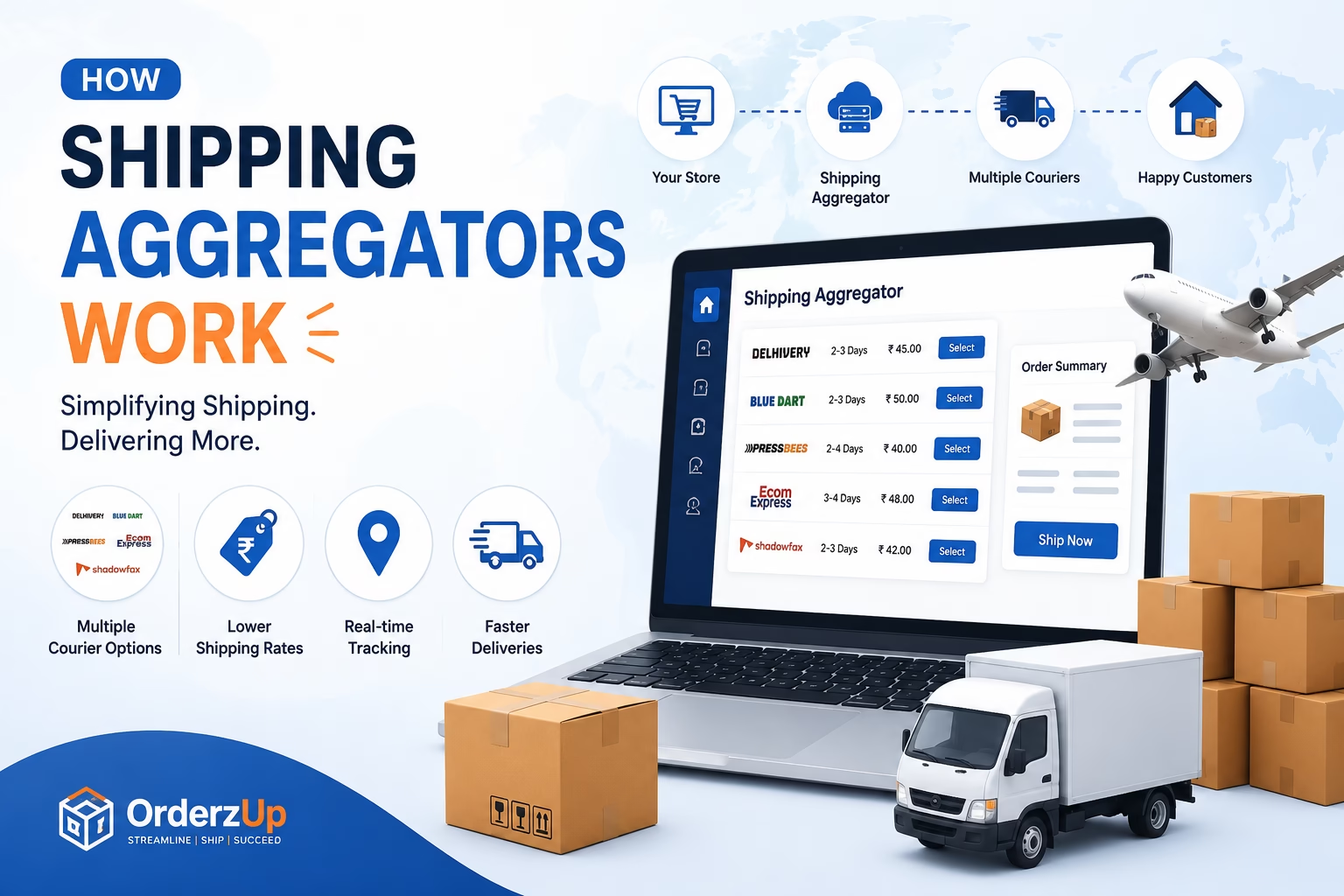
The Complete Workflow Explained
By Team orderzup.com | Updated: May 2026 | Reading Time: ~10 minutes
India’s e-commerce ecosystem is exploding. With over 180 million online shoppers and D2C brands multiplying at an unprecedented pace, one question keeps every founder, operations manager, and supply chain head up at night: How do I ship fast, ship reliably, and ship affordably — all at once?
The answer? A shipping aggregator. If you have come across the term but aren’t entirely sure how it works or which platform is genuinely built for your business, this guide is your complete, no-fluff breakdown how shipping aggregators work.
This article covers everything from the anatomy of a shipping aggregator to a step-by-step workflow, key selection criteria, and an honest look at the best shipping aggregators in India — including why OrderzUp is consistently rated the best courier aggregator in India for D2C and SME brands.
Section 1: What Is a Shipping Aggregator?
A shipping aggregator is a technology platform that integrates multiple courier and logistics partners under a single unified interface. Instead of signing contracts with five different courier companies, managing five different dashboards, and reconciling five different billing statements, you plug into one aggregator and get access to all of them simultaneously.
Think of it as a marketplace for courier services — but with smart automation, real-time rate comparison, automated label generation, and centralized tracking baked in.
Shipping Aggregator vs. Direct Courier vs. 3PL — What’s the Difference?
| Feature | Direct Courier | 3PL Provider | Shipping Aggregator (e.g., OrderzUp) |
| Multiple Carriers | No — single carrier | Depends on contract | Yes — 30+ carriers |
| Rate Comparison | No | Limited | Real-time, automated |
| Integration Effort | High (per carrier) | High (per 3PL) | Single API/dashboard |
| Minimum Volume | Often required | Often required | No minimums (OrderzUp) |
| NDR Management | Manual | Partial | Automated AI-driven |
| COD Remittance | Per carrier | Per 3PL | Unified & faster |
| Scalability | Low | Medium | High — built to scale |
| Best For | High-volume single route | Enterprise warehousing | D2C, SME, e-commerce |
Section 2: How Shipping Aggregators Work — The Complete Workflow
Understanding the mechanics behind a shipping aggregator demystifies why it’s so powerful. Here is the step-by-step workflow, from order placement to cash in your account.
01 Order Ingestion & Store Integration
The workflow begins the moment a customer places an order. Shipping aggregators like OrderzUp integrate with all major e-commerce platforms — Shopify, WooCommerce, Magento, Amazon, Flipkart, and custom storefronts via REST API. Orders are automatically pulled into the aggregator dashboard in real time, eliminating manual data entry entirely.
02 Intelligent Courier Recommendation Engine
Once an order lands, the aggregator’s algorithm evaluates multiple variables: origin pin code, destination pin code, package weight and dimensions, COD vs prepaid, service level (express vs surface vs economy), courier performance history for that route, and current real-time carrier capacity. The system then recommends the optimal carrier — balancing speed, cost, and reliability — or allows you to set your own routing rules using smart automation logic.
03 Automated Label Generation & Manifest Creation
With a courier selected, the platform auto-generates a compliant shipping label, a pickup manifest, and all required documentation in seconds. No manual typing, no formatting errors, no compliance headaches. Labels are print-ready for thermal printers and standard A4 sheets.
04 Pickup Scheduling & Handover
The aggregator communicates directly with the selected courier’s API to schedule a pickup from your warehouse or fulfilment centre. You get a confirmed pickup time window, and the courier partner collects the shipment. Some platforms, including OrderzUp, also support drop-off at courier hubs for brands operating lean, distributed models.
05 Real-Time Shipment Tracking & Customer Notifications
From pickup to delivery, every milestone is tracked — ingested, in-transit, out-for-delivery, delivered, or exception. The aggregator normalises tracking data across all carriers into a single, branded tracking experience. Automated SMS, WhatsApp, and email notifications are triggered at each stage, dramatically reducing ‘Where is my order?’ (WISMO) support queries.
06 Non-Delivery Report (NDR) Management
When a delivery attempt fails, the NDR workflow kicks in. The aggregator flags the shipment, captures the reason code from the courier, and triggers a re-attempt workflow. Advanced platforms like OrderzUp use AI-driven NDR management to classify return risk, auto-trigger customer outreach for address confirmation, and intelligently retry — saving brands from avoidable Return-to-Origin (RTO) losses.
07 Returns & Reverse Logistics Processing
When a customer initiates a return, the aggregator handles reverse pickup scheduling, return label generation, and status updates — all from the same dashboard. Efficient reverse logistics directly impacts customer LTV and repeat purchase rate.
08 COD Remittance & Billing Reconciliation
COD remittance is consolidated across all courier partners, reducing the reconciliation nightmare of chasing payments from multiple companies. A unified billing statement gives you a single view of all shipping costs, COD amounts collected, and fees — making it easy to audit, reconcile, and forecast.
OrderzUp Advantage: Unlike most courier aggregators in India, OrderzUp offers T+2 COD remittance cycles, centralised wallet top-up, and automated weight dispute resolution — saving brands an average of 18 hours per month in manual reconciliation work.
Section 3: Why the Indian Market Needs a Specialised Logistics Aggregator
The logistics challenge in India is uniquely complex. With 19,000+ pin codes, uneven last-mile infrastructure, high COD dependency (still 60-65% of e-commerce orders), multi-lingual customer bases, and wildly varying courier performance across metro vs Tier-2 vs Tier-3 cities, no single courier can do it all.
This is exactly why logistics aggregator India platforms have become mission-critical infrastructure for any brand selling online. Here’s what makes the Indian context different:
- COD dominance: India’s COD rate is among the highest globally. You need a courier aggregator that manages COD collection, remittance, and fraud detection seamlessly.
- Pin code coverage: Remote pin codes in Northeast India, hilly regions, and rural areas often require hyper-local carriers. A logistics aggregator India platform must have these niche carriers in its network.
- RTO (Return to Origin) crisis: Indian e-commerce RTO rates average 25-40% for COD orders. Smart NDR automation is not a luxury — it’s a necessity.
- Seasonal demand spikes: Diwali, Big Billion Days, End of Season Sales — you need a platform that can scale from 50 to 5,000 orders a day without SLA degradation.
- Multi-channel complexity: Selling on Amazon, Flipkart, Nykaa, Myntra, and your own Shopify store simultaneously? You need a unified logistics layer.
The D2C Advantage: Logistics Aggregator for D2C Brands
D2C (Direct-to-Consumer) brands have specific shipping requirements that differ sharply from marketplace sellers or enterprise distributors. A logistics aggregator for D2C brands must deliver:
| B | Branded Tracking Experience D2C is about relationship and retention. Customers expect branded tracking pages that reinforce your brand identity — not a generic courier tracking link. OrderzUp provides fully white-labelled tracking pages with your brand logo, colours, and personalised messaging. |
| N | No Minimum Volume Requirements Early-stage D2C brands ship 20-200 orders a day. Most courier aggregators still require minimum volume commitments. OrderzUp’s model has zero minimums — you start from day one and scale at your own pace. |
| A | AI-Powered RTO Reduction High RTO destroys D2C unit economics. OrderzUp’s AI engine scores each COD order for return risk at the time of order placement, enabling smart interventions — prepaid incentives, address verification calls, or selective courier routing — before the shipment even leaves your warehouse. |
| I | Instant Carrier Switching If a carrier underperforms on a particular route, you can switch in seconds — no renegotiation, no contractual lock-in, no waiting for a new account setup. For fast-moving D2C brands, agility is everything. |
| W | WhatsApp-First Communication India’s default communication channel is WhatsApp. OrderzUp integrates shipment notifications natively into WhatsApp, driving higher read rates, fewer WISMO queries, and faster COD confirmations. |
Section 4: Best Shipping Aggregators in India — An Honest Comparison
The Indian shipping aggregator market has matured significantly. Here is a comparison of the leading platforms, evaluated on the criteria that matter most to growing brands:
| Platform | Carrier Network | D2C Focus | NDR Automation | COD Remittance | Pricing Model | Best For |
| OrderzUp ★ | 30+ Carriers | Deep | AI-Driven | T+2 Fastest | Pay-as-you-go | D2C, SME, Scale-ups |
| Shiprocket | 25+ Carriers | Moderate | Rule-based | T+5 avg | Subscription tiers | SME / Amazon sellers |
| Shipway | 20+ Carriers | Moderate | Basic | T+7 avg | Subscription | Shopify-first brands |
| Pickrr (Fynd) | 15+ Carriers | Basic | Manual | T+7 avg | Volume-based | Mid-market |
| Eshipz | 18+ Carriers | Basic | Rule-based | T+7 avg | SaaS | B2B shippers |
| iThink Logistics | 22+ Carriers | Moderate | Basic | T+5 avg | Freemium | Early D2C |
★ OrderzUp consistently outranks competitors on RTO rate reduction, COD remittance speed, and AI-powered logistics intelligence — making it the best courier aggregator in India for brands focused on profitability, not just shipment volume.
Section 5: Why OrderzUp Is the Best Courier Aggregator in India
There are dozens of shipping aggregators claiming to be the best. But ‘best’ is only meaningful when evaluated in context. For Indian D2C brands, SMEs, and fast-growing e-commerce businesses, OrderzUp has systematically built every feature around what matters operationally and financially. Let’s break it down.
1. The OrderzUp Carrier Intelligence Layer
Most aggregators let you compare prices. OrderzUp goes further. Its Carrier Intelligence Layer continuously monitors real-time performance data — delivery success rates by pin code, average transit times, pickup reliability scores, and RTO percentages — for every carrier in its network. When you ship an order, you’re not just comparing prices. You’re comparing predicted outcomes. The system recommends the carrier most likely to deliver successfully on time, not just the cheapest one.
2. OrderzUp’s AI-Driven NDR Ecosystem
RTO is the silent killer of D2C margins. OrderzUp’s NDR management is not a simple retry trigger — it is a full AI ecosystem that classifies each NDR by root cause, predicts re-attempt success probability, auto-triggers the optimal customer outreach (WhatsApp, IVR, SMS), and recommends whether to retry, re-route, or return — all without manual intervention.
The result? OrderzUp clients report an average 28% reduction in RTO rates within 60 days of going live.
3. Fastest COD Remittance in the Industry
Cash Flow is oxygen for D2C brands. OrderzUp offers T+2 COD remittance — two business days after delivery confirmation, funds are credited to your account. Compare this to the industry standard of T+5 to T+7, and you immediately see the working capital advantage. For brands doing ₹50L-₹5Cr per month in COD, this translates to lakhs of rupees freed from the cash flow cycle.
4. Zero-Code Store Integration in Under 10 Minutes
OrderzUp integrates with Shopify, WooCommerce, Magento, OpenCart, Unicommerce, Vinculum, and custom ERP/OMS systems via REST API. For Shopify brands, it’s a one-click plugin install. For enterprises with custom systems, the developer-friendly API with comprehensive documentation and dedicated onboarding support ensures go-live in days, not weeks.
5. Transparent, No-Surprise Pricing
OrderzUp operates on a pure pay-as-you-ship model with no hidden fees, no monthly minimums, and no forced subscription tiers. The rates you see are the rates you pay. Every charge — fuel surcharges, ODA (Out of Delivery Area) fees, COD handling fees — is disclosed upfront and reflected accurately in your billing dashboard.
| “ We tried three different courier aggregators before OrderzUp. The difference was immediately obvious. Our RTO dropped from 34% to 21% in the first month. The COD remittance cycle actually helps us reorder inventory faster. And when something goes wrong — and in logistics, something always goes wrong — their support team is on it within minutes. — Priya Sharma, Founder, Ahana Naturals | D2C Skincare Brand, 3,000+ orders/month |
Section 6: How to Choose the Right Shipping Aggregator for Your Business
With multiple courier aggregators in India competing for your business, the selection framework matters more than ever. Here are the 8 criteria every brand should evaluate before committing:
- Carrier Network Depth — Does the aggregator cover your top origin and destination pin codes with multiple carrier options? The more redundancy, the more resilient your operations.
- RTO Management Capability — What percentage RTO reduction do existing clients report? Do they have AI-driven NDR automation or just basic rule-based triggers?
- COD Remittance Speed — How quickly does the aggregator pay back collected COD? T+2 vs T+7 has a massive cash flow impact.
- Technology Stack & Integrations — Does the platform integrate natively with your storefront, OMS, or ERP? What is the API quality like?
- Pricing Transparency — Are all fees disclosed upfront? Watch out for hidden surcharges that inflate effective shipping costs by 15-20%.
- Weight Dispute Resolution — Weight discrepancies from couriers are common and costly. Does the aggregator have automated dispute filing and resolution?
- Support Quality & SLAs — When a shipment goes wrong, how fast can you reach a human? What is the escalation path?
- Scalability & Reliability — Can the platform handle 10x your current volume during peak season without downtime or rate degradation?
Quick Tip: Ask any aggregator for the average RTO rate and COD remittance timeline of their top 50 D2C clients. That data alone will tell you more than any feature comparison sheet.
Section 7: Frequently Asked Questions About Shipping Aggregators
What is the difference between a shipping aggregator and a courier company?
A courier company operates its own fleet and delivery network. A shipping aggregator does not own any fleet — instead, it acts as a technology intermediary, connecting you to multiple courier companies through a single platform. The aggregator adds value through rate comparison, automation, tracking normalisation, and consolidated billing.
Is a shipping aggregator suitable for a brand doing fewer than 100 orders per day?
Absolutely. In fact, early-stage brands benefit most from aggregators because they get access to negotiated carrier rates (that would normally require volume commitments) from day one. OrderzUp, for instance, has no minimum order requirements — you can start with your very first shipment.
How does a logistics aggregator reduce RTO for D2C brands?
The best logistics aggregators use AI models trained on millions of shipment data points to identify high-risk COD orders, flag suspicious delivery addresses, auto-trigger customer confirmation outreach before dispatch, and optimise courier selection by historical RTO rate at the pin-code level. OrderzUp’s multi-layer RTO reduction stack operates at each of these touchpoints.
What does ‘best courier aggregator in India’ actually mean?
The ‘best’ aggregator is context-dependent. For a D2C brand focused on RTO reduction and brand experience, the best courier aggregator in India would prioritise AI-driven NDR management, branded tracking, and fast COD remittance — all core OrderzUp strengths. For a high-volume marketplace seller, bulk rate negotiation may take priority. Always evaluate against your specific operational and financial goals.
How secure is my customer data on a shipping aggregator platform?
Reputable aggregators like OrderzUp adhere to data security best practices including AES-256 encryption for data at rest, TLS 1.3 for data in transit, role-based access controls, and GDPR-aligned data handling policies. Always verify the platform’s data processing agreement before onboarding.
Can a shipping aggregator handle international shipping?
Many aggregators focus exclusively on domestic shipping. OrderzUp offers cross-border shipping capabilities in addition to domestic, with integration to international courier networks — making it a single platform for brands that ship both within India and globally.
Section 8: The Future of Shipping Aggregation in India
The logistics aggregator space in India is evolving rapidly. Here are the key trends that will define the next three to five years:
- Hyperlocal & Quick Commerce Integration: As 10-minute delivery expectations creep from grocery into general e-commerce, aggregators will need to integrate hyperlocal delivery partners alongside traditional courier networks.
- Predictive Logistics Intelligence: AI will move from reactive (flagging failed deliveries) to predictive (anticipating delivery failure before dispatch and routing around it).
- Sustainability & Green Shipping: Carbon tracking, route optimisation for emission reduction, and EV-based last-mile delivery will become table-stakes features as ESG requirements increase.
- Embedded Fintech: Aggregators will deepen into financial services — shipping credit lines, invoice discounting against COD receivables, and insurance products embedded directly into the shipping workflow.
- Vernacular & Voice Interfaces: As logistics operations move into Tier-2 and Tier-3 India, platforms will need to support regional language interfaces and voice-activated operations management.
OrderzUp is already investing in the next generation of logistics intelligence — including predictive routing, embedded financial services, and vernacular support — to ensure its brand partners stay ahead of the curve.
Conclusion: Shipping Smarter Starts with the Right Aggregator
A shipping aggregator is no longer a ‘nice to have’ for Indian e-commerce brands — it is foundational infrastructure. The right platform compresses shipping costs, reduces RTO losses, improves customer experience, accelerates cash flow, and frees your team from logistics firefighting so they can focus on growth.
Whether you are a bootstrapped D2C founder shipping your first hundred orders or a scaling brand looking to bring your logistics stack under control, the framework is the same: evaluate on carrier depth, RTO performance, COD speed, technology quality, and pricing transparency.
By those measures, OrderzUp stands apart as the best shipping aggregator in India for brands that care about profitability, brand experience, and sustainable growth — not just raw shipment volume.
| Ready to Simplify Your Shipping? Join 500+ brands already shipping smarter with OrderzUp. ✔ No Minimums ✔ 30+ Carriers ✔ T+2 COD Remittance ✔ AI-Powered NDR Start for Free at www.orderzup.com |