
TOP 10 FEATURES TO LOOK FOR IN A
A Complete Guide for D2C Brands, Shopify Sellers & Ecommerce Founders
By Team orderzup.com | Updated: May 2026 | Reading Time: ~10 minutes
Introduction: Why Choosing the Right Shipping Aggregator Matters
India’s ecommerce sector is projected to reach $350 billion by 2030, driven by a surge in D2C brands, quick-commerce platforms, and Shopify-powered storefronts. At the heart of this growth is one of the most complex operational decisions any online seller will make: choosing the right shipping aggregator.
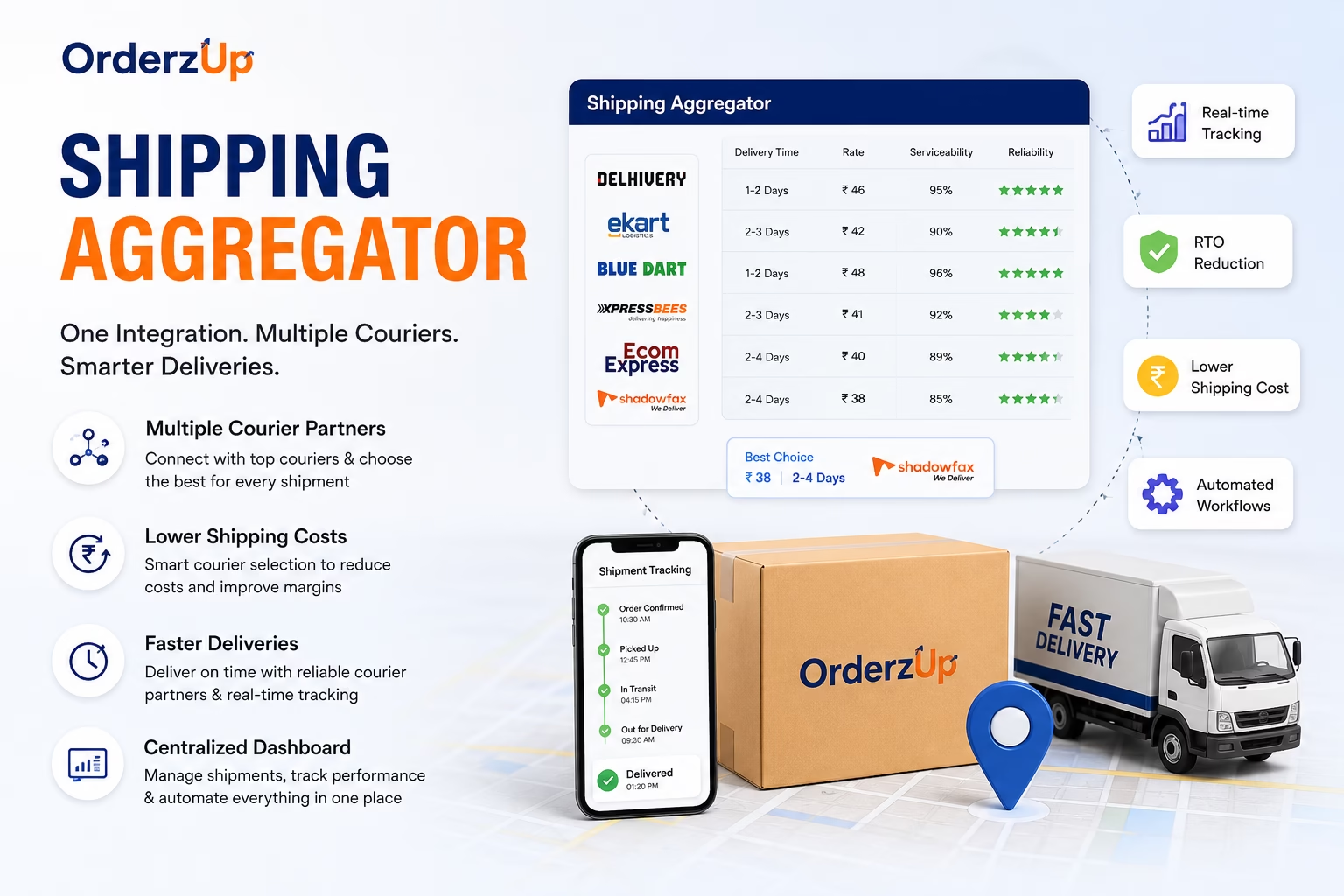
A shipping aggregator — sometimes called a courier aggregator or logistics aggregator — is a software platform that integrates with multiple courier partners (such as Delhivery, Blue Dart, Ecom Express, XpressBees, DTDC, and Shadowfax) under a single interface. Instead of managing individual courier contracts, rate negotiations, and tracking dashboards separately, sellers use a single platform to compare rates, allocate shipments, and monitor deliveries in real time.
But not all aggregators are equal. The platform you choose directly impacts your delivery success rate, Return-to-Origin (RTO) percentage, Cash on Delivery (COD) remittance speed, customer experience, and ultimately, your bottom line.
📦 According to industry estimates, Indian ecommerce logistics handled over 10 billion shipments in FY 2023–24. RTO rates in fashion and lifestyle segments can reach 30–40%, making platform choice a critical cost lever for growing brands.
This guide breaks down the 10 most important features to evaluate when selecting a shipping aggregator in India, with practical comparisons, workflow insights, and decision-making frameworks for D2C founders, logistics managers, and operations teams.
Key Takeaways
- Multi-courier access is the foundation — a good aggregator should offer 15+ courier integrations across metro, non-metro, and hyperlocal routes.
- NDR (Non-Delivery Report) management and RTO reduction tools can save brands 8–15% of their logistics costs.
- Branded tracking pages and post-purchase communication significantly improve customer retention and reduce WISMO (Where Is My Order) queries.
- COD remittance cycles and fraud detection are critical for cash-flow-sensitive businesses operating in Tier 2/3 India.
- API quality and platform integrations (Shopify, WooCommerce, Unicommerce) determine how seamlessly the aggregator fits into your tech stack.
- Real-time analytics with courier performance benchmarking helps brands make data-driven allocation decisions.
- Pricing transparency — hidden platform fees, weight dispute handling, and fuel surcharges — is often more impactful than headline courier rates.
- Warehouse and fulfillment integration capabilities matter for brands planning to scale or use third-party logistics (3PL) providers.
- Serviceable pin code reach — especially for Tier 2 and Tier 3 cities — defines addressable market coverage.
- Customer support SLAs and escalation mechanisms determine how quickly operational issues get resolved.
What Is a Shipping Aggregator Platform? (Definition)
A shipping aggregator platform is a technology layer that sits between an ecommerce seller and multiple courier companies. It provides:
- A unified API or dashboard to compare courier rates and ETAs
- Automated shipment allocation rules based on cost, speed, or pin code coverage
- Consolidated tracking across all couriers
- Single-point billing and reconciliation
- NDR management, RTO reduction, and reverse logistics workflows
Popular examples of shipping aggregators operating in India include Shiprocket, Delhivery (as a platform), Nimbus Post, iThink Logistics, Pickrr (acquired by Delhivery), Eshipz, Vamaship, and newer API-first platforms like OrderzUp. Each has a different feature set, courier network, and pricing structure.
Key distinction: A courier company (e.g., Blue Dart or XpressBees) provides delivery services. A shipping aggregator gives you access to multiple courier companies through one platform. Some courier companies also offer aggregator-like platforms, but their network is limited to their own fleet.
Top 10 Features to Evaluate in a Shipping Aggregator Platform
Feature 1: Multi-Courier Integration & Network Depth
The primary value of any shipping aggregator is access to multiple courier partners. However, the number of integrations alone is not sufficient — what matters is the quality, reliability, and geographic spread of those integrations.
What to Look For
- Minimum 12–15 active courier integrations, covering metro, Tier 2/3, and J&K/Northeast India
- Surface-level integration vs. deep API integration (live AWB generation, real-time status updates, POD retrieval)
- Hyperlocal delivery options (Shadowfax, Dunzo, Porter) for same-day and quick commerce
- International shipping options if your brand ships overseas
- Air freight vs. surface courier splits for weight-sensitive products
Why It Matters
A robust multi-courier ecosystem allows you to use the fastest courier for a time-sensitive order, the cheapest for a non-urgent B2B shipment, and the most reliable for a high-value COD delivery — all from one platform. Shiprocket, for example, integrates with 25+ courier partners. Newer platforms like OrderzUp are building API-first integration architectures that allow near-real-time courier switching based on live SLA data.
💡 Practical Check: Before signing up, ask the aggregator for a pin code serviceability report for your top 50 customer locations. Gaps in coverage translate directly to cancelled orders or forced courier upgrades.
Feature 2: Smart Automated Courier Recommendation Engine
Not every shipment is the same. A 500g cosmetics order to Bengaluru has different logistics requirements than a 5kg electronics order to a rural Rajasthan pin code. A mature shipping aggregator platform should include an intelligent recommendation engine that factors in multiple variables simultaneously.
Variables a Good Recommendation Engine Uses
- Weight and volumetric weight of the package
- Delivery pin code serviceability and last-mile type (urban, rural, hyperlocal)
- Courier SLA (estimated days to delivery)
- Real-time courier performance scores (delivery percentage, RTO rate by zone)
- COD availability and remittance cycle
- Seller-defined rules: e.g., ‘always use Blue Dart for orders above ₹3,000’
The best platforms allow sellers to create rule-based automation — for instance, routing all COD orders in Maharashtra to one courier and prepaid orders to another, or excluding a courier that has shown poor performance in a particular state.
Feature 3: NDR Management & RTO Reduction Tools
Non-Delivery Reports (NDR) and Return to Origin (RTO) are among the most expensive problems in Indian ecommerce logistics. When a delivery attempt fails — because the customer was unavailable, the address was incorrect, or the customer refused the parcel — the shipment enters NDR status. If unresolved, it results in RTO, where the package is shipped back to the seller at additional cost.
For COD-heavy businesses, RTO rates of 20–35% are common without intervention. With active NDR management, many brands reduce RTO by 25–40%.
NDR Management Workflow: With vs. Without
| Stage | Without NDR Management | With NDR Management |
| Delivery Attempt 1 | Courier marks failed, no action | Alert sent to customer within 2 hrs |
| Follow-up | Manual check by ops team | Automated WhatsApp/IVR retry triggered |
| Rescheduling | Customer calls helpdesk | Customer self-selects slot via link |
| RTO Decision | Default return after 3 tries | Rules-based: extend window or initiate return |
| Data Captured | None | Failure reason, location, customer response logged |
What to Look for in NDR Tools
- Automated customer outreach via WhatsApp, SMS, IVR after a failed delivery attempt
- Customer self-service portal to reschedule or update delivery address
- Fake delivery attempt detection (courier marks delivered without actual delivery)
- NDR reason classification (customer unavailable, wrong address, refused, etc.)
- Dashboard to track NDR resolution rates by courier and geography
📊 Industry data suggests that platforms with structured NDR workflows achieve delivery success rates of 92–96%, compared to 78–85% without active management.
Feature 4: Branded Tracking Experience & Post-Purchase Communication
The post-purchase period — from order confirmation to delivery — is one of the highest-anxiety phases for online shoppers. WISMO (Where Is My Order) queries account for a significant percentage of customer support tickets for ecommerce brands. A well-designed shipping aggregator offers branded tracking pages that keep customers informed and reduce support load.
Components of a Branded Tracking Experience
- Custom tracking page with your brand’s logo, colors, and domain
- Real-time order status updates (Order Confirmed → Picked Up → In Transit → Out for Delivery → Delivered)
- Proactive notifications via WhatsApp, SMS, and email at each milestone
- Expected delivery date display (EDD) that adjusts dynamically
- Product upsell/cross-sell tiles on tracking page (NPS survey, review requests)
- Delivery feedback collection post-delivery
Platforms like Shiprocket and iThink Logistics offer basic branded tracking. API-first aggregators like OrderzUp provide deeper customization options, including white-label tracking domains and webhook-based integration with CRM tools, enabling brands to trigger loyalty campaigns at the moment of delivery confirmation.
Feature 5: COD Management, Remittance Speed & Fraud Detection
Cash on Delivery remains the dominant payment method in Indian ecommerce, accounting for approximately 50–60% of orders in Tier 2 and Tier 3 cities. The ability of a shipping aggregator to handle COD efficiently — collect cash from customers, remit it to sellers, and flag fraudulent orders — is a critical feature for most Indian D2C brands.
Key COD Features to Evaluate
- COD remittance cycle: T+2 to T+7 is standard; look for faster options (T+1) for cash-flow-sensitive businesses
- COD remittance dashboard: real-time visibility into collected amounts, pending remittances, and reconciled amounts
- COD fraud detection: address verification, order history analysis, customer behavior scoring to flag risky orders
- COD to prepaid conversion: automated messages encouraging customers to switch from COD to UPI before dispatch
- Partial COD collection support
Unresolved COD reconciliation disputes are a significant pain point for sellers. Before choosing an aggregator, review their reconciliation SLA and dispute resolution process. Some platforms offer escrow-style COD holding with real-time ledger access, which improves transparency considerably.
💰 A 1-day improvement in COD remittance cycle for a brand shipping 500 COD orders/day at an average order value of ₹800 can free up ₹4 lakh in working capital daily.
Feature 6: Shipping Rate Comparison & Transparent Pricing
One of the primary value propositions of a shipping aggregator is access to negotiated rates across multiple courier partners. However, the headline rate comparison is only one part of the cost picture. Hidden charges — weight rounding, fuel surcharges, remote area surcharges, and COD handling fees — can significantly inflate the actual cost per shipment.
Rate Comparison: What to Look at
- Dead weight vs. volumetric weight billing (most couriers use the higher of the two)
- Weight slab structure: 500g slabs vs. 100g slabs vs. actual weight
- First-mile pickup fees (free vs. charged)
- Remote area delivery surcharges by pin code
- COD handling charges (typically 1–2% of order value or ₹30–₹60 flat)
- Reverse logistics rates (return shipping cost as a % of forward shipping)
- Platform fee or commission structure of the aggregator itself
Pricing Model Comparison
| Pricing Model | Best For | Risk Level | Example Platforms |
| Per-shipment fee (flat) | High-volume brands | Low | Delhivery, Blue Dart (direct) |
| Percentage of shipping cost | SMBs & startups | Medium | Shiprocket, Pickrr |
| Monthly subscription + per-ship | Scaling D2C brands | Low-Medium | iThink, Nimbus Post |
| Freemium + paid tiers | Early-stage sellers | Very Low | OrderzUp, Eshipz |
When comparing aggregators, request a complete rate card inclusive of all surcharges and test it against your actual shipment data from the past 90 days. The platform with the lowest base rate may not be the cheapest once all-in costs are calculated.
Feature 7: Real-Time Analytics, Courier Performance Benchmarking & Reporting
Data is the competitive advantage in modern logistics operations. A shipping aggregator should not just move packages — it should help you understand how your logistics network is performing and where it’s costing you money.
Analytics Capabilities to Look For
- Shipment volume trends by channel, SKU, geography, and courier
- Delivery performance metrics: on-time delivery rate, average transit days by courier and zone
- RTO analytics: RTO rate by courier, region, product category, and payment type
- NDR analytics: resolution rate, average resolution time, failure reason breakdown
- COD analytics: collection rate, remittance lag, pending amount aging
- Weight and billing analytics: declared vs. billed weight discrepancy reports
- Customer experience metrics: tracking page visits, WISMO reduction rates
Advanced platforms provide predictive analytics — for example, flagging a courier that is showing early signs of SLA deterioration in a specific zone before it impacts your delivery rates. This allows proactive reallocation. Platforms like OrderzUp are developing AI-assisted courier scoring models that dynamically adjust routing weights based on rolling performance data.
📈 Brands that actively use courier performance data to reallocate shipments typically see a 12–18% improvement in delivery success rates within 60 days of implementation.
Feature 8: API Quality, Platform Integrations & Ecosystem Compatibility
For ecommerce operations teams managing hundreds or thousands of shipments daily, manual processing is not an option. A shipping aggregator’s API quality and pre-built integrations determine how seamlessly it fits into your existing tech stack and how much engineering effort is required to maintain the connection.
Integration Checklist
- Shopify, WooCommerce, Magento, and custom store integrations
- Marketplace integrations: Amazon, Flipkart, Meesho, Myntra
- ERP and OMS integrations: Unicommerce, Vinculum, Increff
- WMS (Warehouse Management System) integrations
- CRM and helpdesk integrations: Freshdesk, Zendesk, Zoho
- Accounting integrations: Tally, QuickBooks, Zoho Books
API Quality Indicators
- REST API with comprehensive documentation and sandbox environment
- Webhook support for real-time event notifications (shipment status changes)
- Rate limiting policies and uptime SLA (look for 99.9% uptime guarantee)
- Bulk API for high-volume order processing
- SDK availability (Python, Node.js, PHP) for engineering teams
API-first aggregators like OrderzUp have been built with developer experience as a core design principle, offering comprehensive REST APIs, interactive documentation, and sandbox environments that allow technical teams to prototype integrations rapidly. This is particularly important for D2C brands building custom checkout and OMS workflows.
Feature 9: Reverse Logistics & Returns Management
Returns are a significant operational challenge for Indian ecommerce brands, particularly in high-return categories like apparel (return rates of 20–35%) and footwear. A shipping aggregator’s reverse logistics capabilities determine how efficiently returned inventory is processed and restocked.
Reverse Logistics Features to Evaluate
- Self-service customer returns portal (customer initiates pickup online)
- Return pickup scheduling with customer-chosen time slots
- Multiple courier routing for returns (forward courier may not be optimal for returns)
- QC (Quality Check) integration with 3PL or warehouse partners
- Real-time return shipment tracking
- Return analytics: return rate by SKU, category, geography, and return reason
- Exchange workflow support (not just return and refund)
Some aggregators have also introduced customer-facing return management tools that allow brands to convert a return into an exchange, preserving revenue. This is increasingly important as return costs (reverse shipping + restocking) can erode margins significantly, particularly for sub-₹500 order values.
Feature 10: Customer Support Quality, SLA Transparency & Escalation Matrix
When a high-value shipment is lost, a customer is calling about a damaged parcel, or a courier is failing an entire zone — the quality of your shipping aggregator’s customer support becomes mission-critical. This is an area that is frequently under-evaluated during the platform selection process.
Support Features That Matter
- Dedicated account manager for brands above a shipment threshold
- Multiple support channels: live chat, email, WhatsApp, phone
- Support SLA commitments: first response time, resolution time by issue type
- Escalation matrix: clear path from L1 → L2 → courier liaison for complex issues
- Proactive alerts for network disruptions (weather, courier strikes, system outages)
- Self-service knowledge base and help center for common operational queries
One practical approach is to test a platform’s support responsiveness before signing a long-term contract. Create a test account, raise a few support tickets on non-critical topics, and evaluate response time, quality, and resolution. This reveals more about day-to-day operational experience than any feature checklist.
Shipping Aggregator Feature Comparison: India Market Overview
The table below provides a high-level feature comparison of major shipping aggregator platforms operating in India as of 2024–25. Note that platform capabilities evolve rapidly; always verify current features directly with the vendor.
| Platform / Feature | Multi-Courier | Branded Tracking | NDR Mgmt | COD Remittance | Analytics | API + Integrations |
| Shiprocket | ✔ | ✔ | ✔ | ✔ | Moderate | Extensive |
| Delhivery Direct | ✗ | ✗ | ✔ | ✔ | Basic | Limited |
| Pickrr / Eshipz | ✔ | ✔ | ✔ | ✔ | Moderate | Good |
| iThink Logistics | ✔ | ✔ | ✔ | ✔ | Good | Good |
| OrderzUp | ✔ | ✔ | ✔ | ✔ | Advanced | API-First |
| Nimbus Post | ✔ | ✔ | ✔ | ✔ | Good | Good |
Note: This comparison is for informational purposes only, based on publicly available information and industry research. Feature sets and capabilities change frequently; brands should conduct their own due diligence before selecting a platform.
How to Evaluate a Shipping Aggregator: A Step-by-Step Framework
Step 1 — Map Your Shipment Profile
- Calculate average daily shipment volume by weight, category, and geography
- Identify your top 20 destination pin codes and check serviceability with shortlisted platforms
- Determine your COD vs. prepaid split and average order value
Step 2 — Identify Non-Negotiable Requirements
- Same-day or next-day delivery SLA for specific markets?
- Specific marketplace integrations required?
- In-house tech team for API integration, or need for a plug-and-play solution?
Step 3 — Run a Parallel Pilot
- Test 2–3 platforms simultaneously with a subset of shipments (500–1,000 orders minimum)
- Measure actual delivery rate, RTO rate, and customer tracking engagement
- Evaluate support quality during the pilot by raising real operational queries
Step 4 — Conduct a True Cost Analysis
- Pull actual billed amounts from pilot period and calculate cost-per-shipment all-in
- Include platform fees, courier charges, COD fees, weight discrepancy adjustments
- Model out cost at your projected 12-month shipment volume
Step 5 — Negotiate and Review Contract Terms
- Minimum commitment volumes and penalties for under-shipment
- Rate revision clauses (how often and by how much can rates increase?)
- Data portability: can you export your shipment history if you switch platforms?
- Exit clause: notice period and process for migrating to a different aggregator
Industry Outlook: The Future of Shipping Aggregation in India
The Indian logistics technology market is in a period of rapid transformation. Several trends are reshaping what brands should expect from shipping aggregator platforms over the next 3–5 years.
AI-Driven Routing and Predictive Logistics
Machine learning models are being deployed to predict delivery success probability, identify high-risk orders for COD fraud, and dynamically adjust courier allocation in near-real-time. Platforms investing in AI infrastructure — including API-native aggregators like OrderzUp — will offer significantly more accurate SLA commitments and lower RTO rates compared to rule-based systems.
Same-Day and Quick Commerce Expansion
The rapid growth of 10-minute and same-day delivery expectations (driven by quick commerce platforms like Blinkit, Zepto, and Swiggy Instamart) is pushing shipping aggregators to integrate hyperlocal fulfillment networks. Aggregators that build pre-integrated hyperlocal courier APIs will have a significant advantage for D2C brands entering quick commerce.
Embedded Logistics Finance
COD remittance acceleration and working capital products are emerging as competitive differentiators. Some aggregators are exploring embedded lending — offering brands early access to collected COD funds as a short-term credit facility. This is particularly relevant for high-volume, cash-flow-sensitive businesses in Tier 2/3 India.
Returns Monetization
The reverse logistics segment is evolving from a cost center to a potential revenue center. Platforms that can facilitate instant exchanges, offer return merchandise authorization (RMA) workflows, and connect sellers with liquidation buyers will provide measurable value beyond shipping cost optimization.
Regulatory and GST Compliance Automation
As GST enforcement tightens around ecommerce logistics, shipping aggregators are building automated e-way bill generation, GST invoice reconciliation, and GSTIN-linked shipment tracking into their platforms. This reduces compliance overhead for brands operating across multiple states.
🔮 The shipping aggregator market in India is expected to consolidate significantly over 2025–2027, with platform differentiation shifting from courier count to AI capabilities, financial products, and post-purchase experience tools.
Frequently Asked Questions (FAQ)
Q: What is the best shipping aggregator in India for D2C brands?
A: There is no universally ‘best’ aggregator — the right choice depends on your shipment volume, product category, geographic footprint, COD vs. prepaid split, and tech stack. Shiprocket is widely used for its courier network and ease of use. Nimbus Post and iThink Logistics are popular for competitive rates. API-first platforms like OrderzUp are gaining adoption among tech-forward brands that need deeper customization. Conduct a parallel pilot before committing.
Q: What is a courier aggregator vs. a 3PL provider?
A: A courier aggregator (shipping aggregator) gives you access to multiple courier companies under one platform — you still manage your own inventory and packing. A third-party logistics (3PL) provider takes over warehousing, packing, and often shipping on your behalf. Some aggregators are moving toward offering 3PL-style fulfillment services, blurring this distinction.
Q: How does NDR management reduce RTO rates?
A: When a delivery attempt fails, the courier generates an NDR. Without active management, the courier makes 1–2 more attempts before initiating a return. With NDR management, the aggregator platform immediately contacts the customer via WhatsApp or IVR, identifies the failure reason, and coordinates a rescheduled delivery with updated information. This typically resolves 40–60% of NDRs that would otherwise convert to RTOs.
Q: What is a reasonable COD remittance cycle for Indian ecommerce?
A: The standard COD remittance cycle is T+5 to T+7 (5–7 business days after delivery). High-volume brands can often negotiate T+2 or T+3 cycles. Some platforms offer T+1 remittance as a premium feature or for brands above a certain monthly volume threshold. Faster remittance significantly improves working capital availability.
Q: Do I need API integration to use a shipping aggregator?
A: No. Most shipping aggregators offer a web dashboard for manual order creation and CSV uploads for bulk processing, which does not require API integration. However, for brands shipping more than 100–200 orders per day, API integration (or a native Shopify/WooCommerce plugin) is strongly recommended to eliminate manual effort, reduce errors, and enable real-time order processing.
Q: What are weight disputes in shipping, and how should aggregators handle them?
A: A weight dispute occurs when the courier bills for a higher weight than the seller declared — due to volumetric weight calculations or measurement discrepancies at the courier’s warehouse. A good aggregator should provide a dispute resolution mechanism where sellers can submit evidence (photos, weight invoices) and the platform disputes the charge with the courier on the seller’s behalf. Review the platform’s dispute SLA and win rate before selecting.
Q: Is it better to use one courier directly or a shipping aggregator?
A: Using a single courier directly may offer slightly better rates at very high volumes (10,000+ shipments/day) with a dedicated account team. However, for most D2C brands, an aggregator provides significant advantages: fallback options during courier disruptions, competitive rate benchmarking, consolidated billing and analytics, and access to NDR management tools that individual couriers do not typically provide.
Q: What pin code coverage should I expect from a shipping aggregator?
A: A mature shipping aggregator in India should offer serviceability to 20,000+ pin codes for surface delivery and 17,000+ for air/express delivery. Coverage of 100% of serviceable Indian pin codes across the aggregated courier network is a reasonable expectation. Verify coverage for your specific target geographies, particularly Northeast India, J&K, and remote Tier 3 markets, which have variable availability across couriers.
Conclusion
Choosing a shipping aggregator in India is not a one-time vendor decision — it is an operational partnership that affects your delivery experience, customer satisfaction, cash flow, and unit economics daily. The best shipping aggregator for your business is the one that aligns with your specific shipment profile, tech requirements, geographic footprint, and growth trajectory.
Evaluate platforms across all 10 dimensions covered in this guide: multi-courier coverage, smart routing, NDR management, branded tracking, COD capabilities, pricing transparency, analytics depth, API quality, reverse logistics, and customer support. No single platform will be perfect across every dimension, but understanding the trade-offs allows you to make a well-informed, data-backed decision.
Run parallel pilots, analyze true all-in cost, stress-test support responsiveness, and review contract terms carefully. As the Indian logistics technology market continues to evolve toward AI-driven automation and embedded financial products, brands that choose flexible, API-capable aggregators will be better positioned to adapt as the landscape changes.
🚀 The right shipping aggregator is not just a cost tool — it is a customer experience tool, a cash flow tool, and a data tool. Evaluate it accordingly.
Glossary of Key Terms
- A report generated by a courier when a delivery attempt fails, indicating the reason and status of the undelivered shipment: NDR (Non-Delivery Report)
- When a shipment cannot be delivered and is sent back to the seller; a major cost driver in Indian ecommerce: RTO (Return to Origin)
- A payment method where the customer pays in cash at the time of delivery; dominant in Tier 2/3 India: COD (Cash on Delivery)
- Customer service queries about order status; high WISMO volume indicates poor post-purchase communication: WISMO (Where Is My Order)
- A calculated weight based on package dimensions (L×W×H ÷ 5000); used when it exceeds actual weight for billing: Volumetric Weight
- A unique tracking number assigned to each shipment by the courier: AWB (Airway Bill)
- A service provider that handles warehousing, fulfillment, and shipping on behalf of a brand: 3PL (Third-Party Logistics)
- The predicted delivery date shown to customers at checkout and on tracking pages: EDD (Estimated Delivery Date)
- Whether a courier can deliver to a specific postal index number; determines geographic reach: PIN Code Serviceability
- A real-time HTTP callback that notifies external systems of shipment status changes without polling: Webhook
This article is intended for informational purposes only. Platform features, pricing, and service capabilities are subject to change. Always verify directly with the platform before making procurement decisions.